
Imagine a vaccine that could eradicate a major source of chronic stress, slash crime rates, boost small businesses, and reduce the gap between the rich and the poor all without costing a fortune to manufacture.
It sounds like a pipe dream, doesn’t it? But this tool already exists. It doesn’t come in a vial, it comes in a curriculum, a conversation, and a mindset. It is financial literacy.
For decades, we have treated understanding money as a personal obligation. If you overspend, it’s your fault. If you don’t invest, you’re left behind. But when millions of individuals simultaneously struggle to manage their money, personal failure morphs into a systemic crisis. Financial literacy is not just an individual life skill, it is a public good. When a society prioritizes financial education, the benefits ripple outward, transforming communities from the ground up.
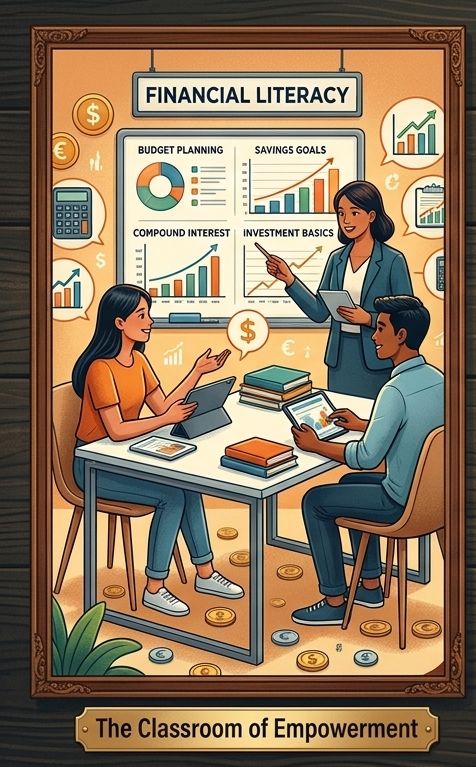
Moving Beyond the “Math” of Money
Before we look at the societal impact, we need to redefine what financial literacy actually means. Many people hear the phrase and immediately envision complex calculus, stock market tickers, and agonizing over spreadsheets
That misperception is exactly why so many people tune out
True financial literacy is much less about math and much more about psychology, behavior, and empowerment. It is the ability to make informed, confident decisions about how you earn, spend, save, borrow, and invest money. It’s understanding the difference between an asset and a liability. It’s knowing that debt can be a ladder or a trap, depending on how you use it. Most importantly, it is the emotional resilience to resist instant gratification in favor of long-term security.
When someone acquires this knowledge, their relationship with the world changes. And when an entire community changes its relationship with money, society transforms.
1. The Bedrock of Economic Stability
The most immediate benefit of a financially literate populace is economic stability. Economies thrive when money flows predictably and productively.
When citizens lack basic financial knowledge, they are far more susceptible to predatory lending, high-interest debt traps, and foreclosure. We saw the catastrophic global consequences of this in the 2008 financial crash, where a widespread lack of understanding regarding complex mortgage products contributed to a systemic collapse.
Conversely, a financially literate society acts as an economic shock absorber. When individuals understand how to build emergency funds and manage cash flow, they are far better equipped to weather macroeconomic storms like recessions, pandemics, or sudden industry shifts. Instead of relying instantly on government safety nets or falling into bankruptcy, financially literate households can sustain themselves through temporary hardships. This resilience at the household level prevents broader economic free falls.
2. Igniting the Engine of Innovation and Entrepreneurship
Every great society relies on innovators, the dreamers who build businesses, create jobs, and solve local problems. But turning a dream into a viable business requires more than just passion, it requires capital management.
A staggering number of small businesses fail not because the product was bad, but because the founder ran out of cash. Financial literacy equips aspiring entrepreneurs with the tools to write realistic business plans, manage overhead costs, understand profit margins, and seek the right kind of funding.
Furthermore, a financially literate society creates better investors. When everyday citizens understand how the stock market, venture capital, and compounding interest work, they don’t just leave their money under a mattress. They invest it back into the economy, funding the very businesses and technologies that drive societal progress.
3. Breaking the Chains of Intergenerational Poverty
Poverty is incredibly expensive. When you don’t have money, you pay more for everything from higher interest rates on loans to fees for cashing checks because you don’t have a traditional bank account.
More than that, poverty leaves a psychological inheritance. Children who grow up in households plagued by financial chaos often inherit a scarcity mindset. They see money as something that vanishes the moment it arrives, leading to a cycle of survival based spending rather than wealth-building.
Financial literacy is the ultimate equalizer. It bridges the gap between privilege and opportunity. When we teach financial literacy in underfunded schools and marginalized communities, we provide a blueprint for breaking the cycle of poverty. It gives individuals the tools to build assets, invest in education, and eventually pass down not just money, but wealth-building knowledge to the next generation.
[Financial Education]
│
▼
[Behavioral Shift: Saving/Investing]
│
▼
[Asset Accumulation & Security]
│
▼
[Intergenerational Wealth & Breaking Poverty Cycles
4. Alleviating the Hidden Epidemic of Mental Health
We cannot talk about the societal benefits of financial literacy without talking about mental health. Money is consistently ranked as one of the leading causes of stress, anxiety, and depression worldwide. It is also one of the primary drivers of marital discord and divorce
The mental toll of financial insecurity doesn’t stay confined to the home. It follows people to work, leading to decreased productivity and higher absenteeism. It strains healthcare systems, as chronic stress manifests as physical illness
By giving people the tools to control their finances, we effectively lower the baseline anxiety of society. A person who knows how to budget and has a clear plan for the future sleep better at night. They are healthier, more present for their families, and more engaged in their workplaces.
SUMMARY
A society’s true wealth is not measured solely by its Gross Domestic Product (GDP) or the height of its skyscrapers. It is measured by the financial security and peace of mind of its average citizen.
When we invest in financial literacy, we aren’t just teaching people how to balance a checkbook or read a stock chart. We are investing in a more stable economy, a more innovative culture, and a fairer, more compassionate world. It is time to stop viewing financial education as a personal luxury and start championing it as a societal necessity. After all, a society that understands its money is a society that owns its future.
 Agarwa collection
Leave a comment